Youth Brazilian Jiu-Jitsu
Our youth jiu-jitsu program helps students develop technique, control their bodies, work with partners, and build resilience.
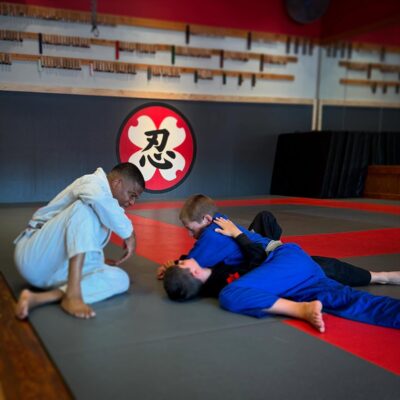
Class Structure
Warm Up
We begin each class with a warm up. This starts with mobility exercises, then moves into foundational jiu-jitsu movements such as shrimping, break falls, and rolls.
Technique
Next, we move into the technique portion of class. Each week has a set curriculum of material. We begin with a foundational movement and then add in drills to continue to refine the technique.
Sparring and Games
The end of class is reserved for sparring and games. Older students will spend this time rolling, the younger groups may roll with specific parameters (like only looking for arm bars) or we may incorporate games that reinforce jiu-jitsu knowledge and positional awareness.
Belt System
We follow the IBJJF Youth Belt System. Students can expect to progress every 6-12 months based on attendance, attitude, and knowledge of fundamentals.
White Belt – The starting point for all students. This is where kids begin building coordination, focus, and comfort on the mat.
Gray Belts (Gray-White, Solid Gray, Gray-Black) – Gray belt is where students really begin to develp their jiu-jitsu. Students will get comfortable with gain knowledge of the different positions and fundamental movements.
Yellow Belts (Yellow-White, Solid Yellow, Yellow-Black) – Yellow belts represent deeper technical understanding and improved control.
Orange Belts (Orange-White, Solid Orange, Orange-Black) – These are more advanced belts that demonstrate knowledge of position, fundamentals, and control while sparring.
Green Belts (Green-White, Solid Green, Green-Black) – The final belts before transitioning to adult ranks. These students show leadership, advanced control, and a comprehensive grasp of jiu-jitsu.
Youth To-Shin Do
Our Youth To-Shin Do program helps students develop a range of skills including the foundations of self-defense, control of their bodies, and the confidence to do hard things.
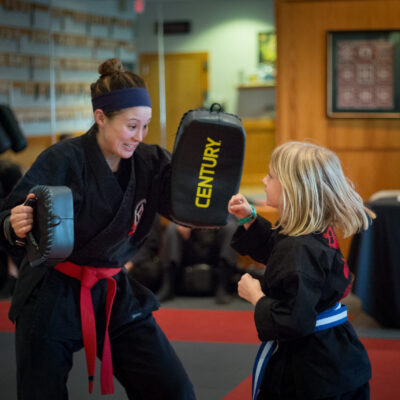
Class Structure
Warm Up
We begin each class with a warm up. It may be a set of exercises, striking drills, or foundational movement drills.
Technique
Next, we move into the technique portion of class. Each week has a set curriculum of material. Unlike jiu-jitsu, To-Shin Do students will spend the majority of their time working on standing self-defense. This includes punch and kick defenses, take downs, and de-escalation techniques.
Randori (free-response) and Games
During randori, students will practice the techniques they have learned in class under pressure. Instructors and other students will be the “attackers” simulating a self-defense situation, and the student will perform the techniques from class to counter it. We also play technical games to review skills.
Belt System
To-Shin Do uses a 5 element model with corresponding belts for each level. Earning a black belt in To-Shin Do takes 4-6 years with consistent training.
White and Yellow Belt – Earth Element – techniques that promote balance, stability, being grounded
Blue Belt – Water Element – shifting angles and taking an opponents balance
Red Belt – Fire Element – controlling the timing of conflict, interrupting attacks
Green Belt – Wind Element – learning to move nimbly and avoid being trapped or pinned down
Brown Belt – Void Element – using skills learned in other elements to anticipate and control a confrontation, setting traps
Black Belt – Advanced Applications – now that you have mastered the elemental movements, you will continue to add and refine techniques.
Try a Free Class!
FAQ's
My child has never done martial arts before, is that okay?
Absolutely! Most students come to us with no experience, and that is totally okay! All classes are all levels, and students can begin martial arts classes at anytime.
Do you offer a free trial class?
Yes! We encourage all students to try out a class first to see if it’s a good fit. Kids are welcome to try a free class in both programs (To-Shin Do and BJJ).
My child loved both programs, do we have to choose?
Nope! Many of our students train in both, and if time allows we believe this is great for their skills development. Being able to have grappling and standing self-defense is an asset! Youth classes are back to back Monday – Thursday and on Saturday, and students often stay and do both classes.
*If you can only make 2 classes per week total, we encourage you to pick one program
Is there a dress code?
Yes.
For To-Shin Do: Students need a gi (uniform), and a black t-shirt or rash guard.
For Jiu-Jitsu: Students need a gi (uniform), a rash guard, and a mouthguard.
We sell gis, rashguards, and mouthguards in our pro-shop, or you are welcome to obtain your own.
Do you have any other programs for kids?
Yes! We offer after-school programs at Durham Academy and Duke School. We also host monthly Parent’s Night Out events and summer camps at our dojo and around the Triangle!